The Role of Homogenizers in Juice Beverage Production
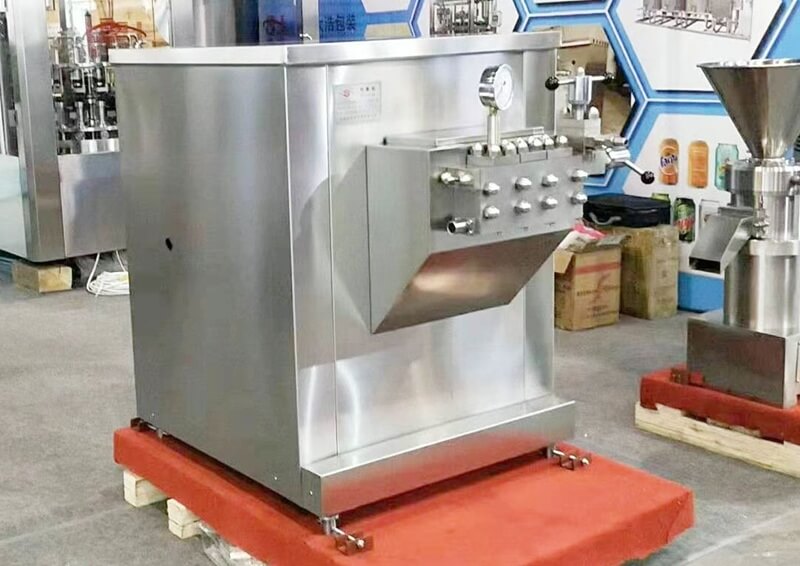
The role of homogenizers in juice beverage production, if you want to make juice or similar beverage, you need to know more about homogenizers. Let’s talk about it:
Usage:
In the production of fruit juice beverages, homogenizers are primarily used for cloudy juices and juice with pulp; clarified juices normally do not need homogenization. The core function of homogenization is to break down and disperse suspended pulp particles, fibers, and colloids, thereby delaying layering and precipitation, improving both taste and color.
Why Homogenize Fruit Juice?
If pulp particles in fruit juice are too large or unevenly distributed. After some time staying they will sink due to density differences, resulting in an increase the clear liquid in up layer and the fruit pulp at the bottom. The homogenization can slows down this sink process physically by refining the particles and narrowing their size distribution.
The homogenization not only bring particle size reduction. High-pressure shearing plant cells, releasing pectin into the juice, which enhances viscosity and suspension stability. When the fruit pulp cell broken, the copene and β-carotene increase, as well as the color and taste become better. Research on cloudy apple juice has further shown, that homogenization pressure is approximately 20 MPa, the taste and color of apple juice become better much.
Basic Principles of Homogenization
High-pressure homogenizers force fruit juice through an extremely narrow valve gap—often some micrometers—under high pressure, then pressure come down soon. This shear forces and high-speed impact break down the fruit pulp. In a two-stage homogenization process, the first stage handles the primary breakdown, while the second stage provides a controlled back-pressure. This can break the pulp two times, effect will be better much.
Typical Process Parameters for Fruit Juice Homogenization
Pressure:
For normal fruit juices, the recommended pressures typically will be the 30–50 MPa, aimed at refining fibers and preventing sedimentation. Some processes adopts low pressure—for instance, a single-stage pressure of 3–20 MPa, or two-stage combinations such as 25 MPa + 5 MPa or 25 MPa + 20 MPa. Ultra-high-pressure homogenization (exceeding 100 MPa) is primarily used for research purposes or specialized non-thermal processing applications, not the standard choice for conventional fruit juice production.
Temperature.
Before homogenization, the temperature of the material should be between 50°C and 70°C, 65°C will be better, it should normally not exceed 85°C. High-pressure homogenization itself causes the temperature to rise due to shear and friction; the temperature increases by about 2–3°C for every 10 MPa of pressure. For heat-sensitive fruit juices, the machine must use cooling jackets or heat exchangers to regulate the outlet temperature.
Number of stages.
A single stage is often sufficient for general particle size reduction; however, for requiring higher stability or those substance easy to re-aggregation, two-stage homogenization will be better.